-1-1.png?width=1500&height=583&name=Poorna_2_Logo_Vector_Kaptius_Final_file-03%20(1)-1-1.png "Poorna_2_Logo_Vector_Kaptius_Final_file-03 (1)-1-1")
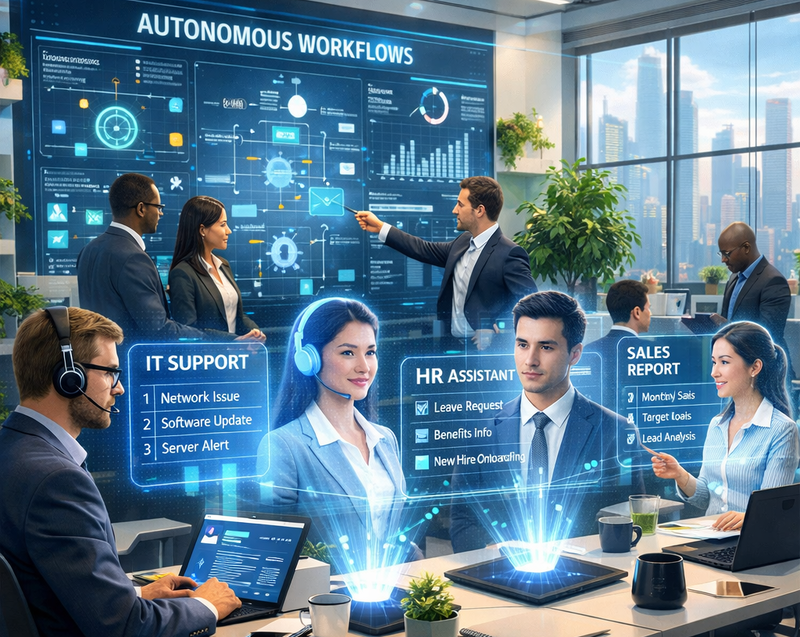

The enterprise software landscape is undergoing one of the most significant shifts in a generation. Artificial intelligence is no longer a feature bolted onto existing platforms, it is becoming the operating system of modern work itself. ServiceNow, long recognized as the backbone of IT service management and enterprise automation, has placed a very large bet on this future. With the introduction of autonomous workflows, the AI-powered workforce, and the L1 Service Desk AI Specialist, the company is not simply upgrading its platform. It is fundamentally reimagining what enterprise work looks like.
This article explores what ServiceNow is building, why it matters, and what organizations should be thinking about as these capabilities become real and available.
The Shift from Automation to Autonomy
There is an important distinction worth making upfront. Automation and autonomy are not the same thing.
Traditional automation in ServiceNow has always been powerful. Workflow Engine, Flow Designer, and Orchestration tools have allowed organizations to eliminate repetitive manual tasks, route tickets, trigger approvals, and connect systems. These tools require humans to define every rule, every condition, every decision tree. The machine executes what it is told.
Autonomous workflows operate on a different level entirely. Rather than following pre-defined rules, autonomous systems can reason, plan, make decisions, and take actions with minimal human intervention. They observe context, understand intent, and determine the best course of action dynamically. The human is no longer the architect of every step. The AI becomes a capable participant in the process itself.
This is the territory ServiceNow is now stepping into aggressively, and the implications for IT operations, HR service delivery, and enterprise productivity are enormous.
Introducing the AI Workforce: ServiceNow's Autonomous Agents
At the center of ServiceNow's AI strategy is the concept of an AI Workforce, a collection of specialized AI agents designed to handle entire categories of work independently. ServiceNow unveiled this vision as part of its broader Now Assist platform evolution, positioning it alongside Agentic AI capabilities that go far beyond simple chatbot interactions.
These agents are not general-purpose assistants. They are purpose-built specialists trained on enterprise data, workflows, and institutional knowledge. Each agent understands its domain, can access relevant systems, execute actions, and escalate intelligently when human judgment is genuinely required.
Think of it as building a team of digital employees. Each one has a defined role, a set of skills, and the ability to operate within established guardrails. They can hand off work between each other, collaborate on complex multi-step tasks, and keep human workers informed without pulling them into every micro-decision.
ServiceNow has been investing heavily in the underlying infrastructure to make this possible, including its integration of large language models, its proprietary domain-specific models trained on ITSM data, and its Now Assist capabilities which are already deployed across millions of enterprise workflows globally.
The L1 Service Desk AI Specialist: A Game-Changing Debut
Perhaps the most concrete and immediately impactful announcement in this space is the L1 Service Desk AI Specialist. This is one of the first fully deployed AI agents within ServiceNow's new workforce model, and it targets one of the most resource-intensive areas in any IT organization: the first-line service desk.
Level 1 support has traditionally been a high-volume, high-cost function. Organizations staff entire teams to handle password resets, software provisioning requests, access issues, VPN troubleshooting, and the endless stream of routine tickets that flood IT queues daily. The work is repetitive, the answers are often predictable, and the human agents involved frequently feel underutilized given the nature of the tasks.
The L1 Service Desk AI Specialist changes this equation dramatically.
This AI agent can handle the full lifecycle of a Tier 1 interaction from the moment a user raises an issue to resolution. It can understand natural language requests through conversational interfaces, search the knowledge base, diagnose common issues, execute remediation actions through system integrations, update tickets, communicate status back to users, and close cases, all without human intervention.
Key capabilities of the L1 Service Desk AI Specialist include:
- Resolving password reset and account unlock requests automatically
- Handling software access provisioning within defined policy guardrails
- Diagnosing and resolving common connectivity and device issues
- Triaging complex issues and routing them to appropriate human specialists with full context
- Continuously learning from resolution patterns to improve over time
- Automated new hire onboarding journeys spanning IT, HR, facilities, and security
- Leave management and benefits query resolution without HR agent involvement
- Cross-departmental request orchestration with full audit trails
- Proactive notifications and status updates to employees throughout a process
- Personalized service delivery based on role, location, and employment history
The business case is compelling. Organizations running 24/7 service desks face significant cost pressures, particularly across time zones. The L1 AI Specialist operates continuously without fatigue, inconsistency, or the delays associated with shift changes. Early indicators from ServiceNow's customer pilots suggest containment rates, meaning issues resolved without human escalation, that substantially outperform traditional self-service tools.
Critically, this is not just a chatbot giving knowledge article suggestions. The agent takes action. It can write back to Active Directory, trigger provisioning workflows, update asset records, and communicate across channels including Microsoft Teams and Slack. The difference between suggesting a fix and executing one is the difference between assistance and autonomy.
Employee Autonomous Workflows: Beyond IT
While the IT service desk is a natural starting point, ServiceNow is extending autonomous workflows into the broader employee experience under the Employee Autonomous Workflows initiative. This represents a significant expansion of scope, covering HR service delivery, facilities, legal, and finance functions.
The vision here is that an employee should be able to navigate any workplace need, whether it is onboarding paperwork, requesting leave, resolving a payroll discrepancy, or setting up a new workspace, through a single intelligent interface. Behind that interface, autonomous agents coordinate the fulfillment across multiple departments and systems, without the employee needing to know which department handles what.
This addresses one of the most persistent frustrations in enterprise organizations. Employees often do not know who to contact for a given issue. They submit requests to the wrong team, wait for redirections, lose context across handoffs, and experience delays that erode trust in internal services. Autonomous employee workflows collapse that complexity into a seamless experience.
Specific capabilities within Employee Autonomous Workflows include:
ServiceNow's Employee Center Pro serves as the front-end hub for these experiences, while the autonomous agents operate behind the scenes across HR Service Delivery, IT Service Management, and other modules. The platform's ability to unify data across these domains gives the AI agents the context they need to make good decisions without constant human oversight.
The Technology Underneath: What Makes This Work
Understanding why ServiceNow is particularly well-positioned in this space requires a look at the technical foundations underpinning these autonomous capabilities.
Now Assist and Generative AI Integration
ServiceNow's Now Assist platform brings generative AI capabilities natively into the workflow layer. Rather than calling an external AI service and returning a text response, Now Assist is embedded in the action layer. It can read ticket context, generate responses, and trigger workflow steps in a single orchestrated motion. This tight integration between language understanding and workflow execution is what elevates these capabilities beyond simple chatbots.
Agentic AI Framework
ServiceNow has built an Agentic AI framework that allows multiple AI agents to plan and execute multi-step tasks, coordinate with each other, and call on tools and system integrations as needed. This is the architecture that makes complex autonomous workflows possible. An agent handling an onboarding request, for example, might spin up sub-agents to handle the IT provisioning task, the facilities desk setup task, and the HR documentation task in parallel, then consolidate outcomes for the employee.
Domain-Specific Model Training
ServiceNow has invested in training models specifically on enterprise ITSM and workflow data rather than relying entirely on general-purpose LLMs. This means the AI agents understand ServiceNow taxonomy, ITIL processes, common enterprise scenarios, and workflow patterns out of the box. Organizations still benefit from customization and fine-tuning on their own data, but the baseline competency is meaningfully higher than trying to deploy a generic AI model against enterprise workflows.
Trust and Guardrails by Design
One concern that surfaces immediately in any discussion of autonomous AI taking action in enterprise systems is trust. What happens when the AI makes a wrong decision? What are the checks in place?
ServiceNow has built guardrails architecture directly into its autonomous agent framework. Organizations can define policy boundaries, approval thresholds, and escalation triggers that the AI must respect. Any action above a defined risk level automatically routes to a human. Full audit trails of every AI action are maintained. And the system is designed with explainability in mind, so when an agent makes a decision, there is a traceable record of why.
This is not an afterthought. Enterprise AI adoption depends entirely on trust, and ServiceNow has recognized that governance infrastructure must come alongside capability expansion.
What This Means for IT and HR Teams
A natural question arises when discussing AI agents capable of handling L1 support and employee workflows independently. What happens to the people currently doing that work?
The honest answer is that roles will change. Some repetitive Tier 1 tasks will be handled by AI at a scale and speed that human teams simply cannot match. But the evidence from early deployments suggests that this shift frees human agents to do higher-value work rather than eliminating roles outright.
IT support professionals who spend less time on password resets and basic provisioning can focus on complex infrastructure issues, security incidents, proactive system improvements, and the kind of nuanced technical troubleshooting that genuinely benefits from human judgment. HR professionals relieved from answering the same benefits questions repeatedly can invest in strategic people programs, case management for complex employee situations, and organizational development initiatives.
The organizations that benefit most from autonomous workflows will be those that intentionally redesign roles and processes around the new capability, not those that simply layer AI on top of existing structures and hope for the best.
Getting Ready for Autonomous Workflows
Organizations considering how to approach ServiceNow's autonomous workflow capabilities should think about a few key areas.
Data quality and knowledge management are foundational. AI agents are only as good as the information they can access. If your knowledge base is outdated, incomplete, or inconsistently structured, autonomous agents will struggle to deliver accurate resolutions. Investing in knowledge hygiene now pays dividends immediately and positions you well for AI deployment.
Process documentation matters more than ever. Autonomous agents need to understand how your organization wants things done. Clearly documented workflows, approval hierarchies, and escalation policies give the AI the context it needs to operate within your specific environment.
Start with high-volume, well-defined use cases. Password resets, access provisioning, and common HR queries are ideal starting points precisely because they are high volume, the resolution paths are well understood, and the cost of errors is relatively low. Building confidence in autonomous systems through these use cases creates the organizational trust needed to expand scope over time.
Governance frameworks need to be in place before you scale. Define what actions AI can take autonomously, what requires human approval, and how you will monitor agent performance. ServiceNow provides tooling for this, but the policy decisions are organizational ones that require deliberate attention.
The Bigger Picture
ServiceNow's push into autonomous workflows and AI workforce capabilities is not happening in isolation. It is part of a broader industry moment where AI is moving from assistant to participant in enterprise operations. Competitors are making similar moves. The question is not whether autonomous AI agents will become a standard part of the enterprise technology stack, but which organizations will be best positioned to use them effectively.
ServiceNow's advantage is its position as the platform of record for service and workflow management across IT, HR, customer service, and operations. The platform already sits at the center of how large organizations get work done. Embedding autonomous AI agents into that existing fabric is a more practical path to enterprise adoption than asking organizations to adopt entirely new systems.
For technology leaders, the message from ServiceNow is clear. The future of service management is not about adding more people to the service desk or deploying slightly smarter ticket routing. It is about deploying intelligent agents that can actually resolve problems, fulfill requests, and orchestrate complex multi-department workflows with minimal human friction.
The L1 Service Desk AI Specialist is an early, concrete example of what that future looks like. Employee Autonomous Workflows are the next horizon. And the roadmap stretching ahead suggests that ServiceNow is building toward a platform where autonomous AI agents handle a majority of routine enterprise work, leaving human teams to focus on the decisions, relationships, and complex challenges that genuinely require human intelligence.
That is a meaningful shift. Organizations that start preparing today will have a significant advantage when these capabilities reach full maturity.
Have a question? Drop us a note using the form below.