

Kubernetes Visibility Agent
Let’s break down how the Kubernetes Visibility Agent functions, step by step, so you can clearly understand how it helps populate your CMDB in ServiceNow.
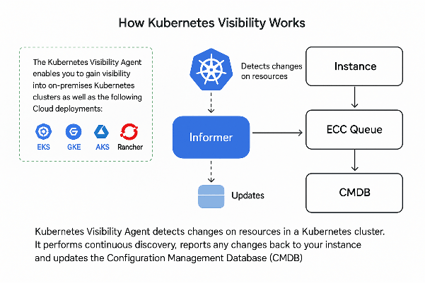
The Kubernetes Visibility Agent supports visibility into:
- On-premises Kubernetes clusters
- Cloud-hosted Kubernetes services like:
- Amazon EKS (Elastic Kubernetes Service)
- Google GKE (Google Kubernetes Engine)
- Microsoft AKS (Azure Kubernetes Service)
- Red Hat
- OpenShift
- Rancher
- This broad compatibility means you can monitor hybrid and multi-cloud environments from a single ServiceNow instance.
- Deployment in Kubernetes
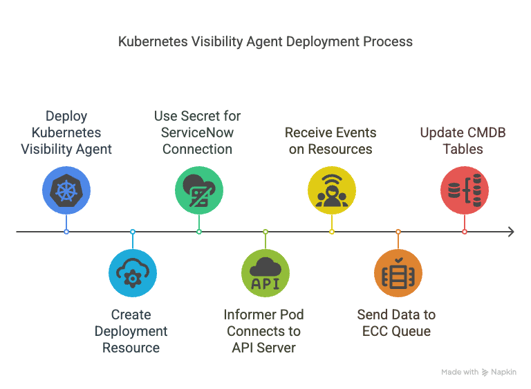
- When you deploy the Kubernetes Visibility Agent, Kubernetes creates a Deployment resource inside your cluster.
- This Deployment is responsible for running the agent.
- To securely connect to your ServiceNow instance, it uses a Kubernetes secret that holds the necessary credentials.
- Role of the Informer Pod
- Inside this Deployment, a pod called Informer is created.
- The Informer plays a critical role - it connects to the Kubernetes API Server.
- It listens to events and changes happening across the cluster - like new pods, services, or nodes being added or removed.
- Sending Data to ServiceNow
- Once the Informer collects this data, it sends it to ServiceNow.
- It does this by using the ServiceNow Table API to interact with the ECC Queue table (External Communication Channel).
- The ECC Queue acts as a communication channel between your Kubernetes cluster and the ServiceNow platform.
- Updating the CMDB
- After reaching the instance, the data is processed. The appropriate CMDB tables are updated with the discovered Kubernetes resources - like clusters, nodes, namespaces, workloads, etc.
- This ensures your CMDB reflects the real-time state of your Kubernetes environment.
Key Benefits- Real-time visibility into your containerized environment.
- Automated population of CMDB with accurate and timely data.
- Seamless integration between Kubernetes and ServiceNow using existing platform features like the ECC Queue and Table API.
Have a question? Just drop us a note!




 Gowtham Yeramanasetti
 Rajkumar Yajjavarapu
 Poornachander Kola